
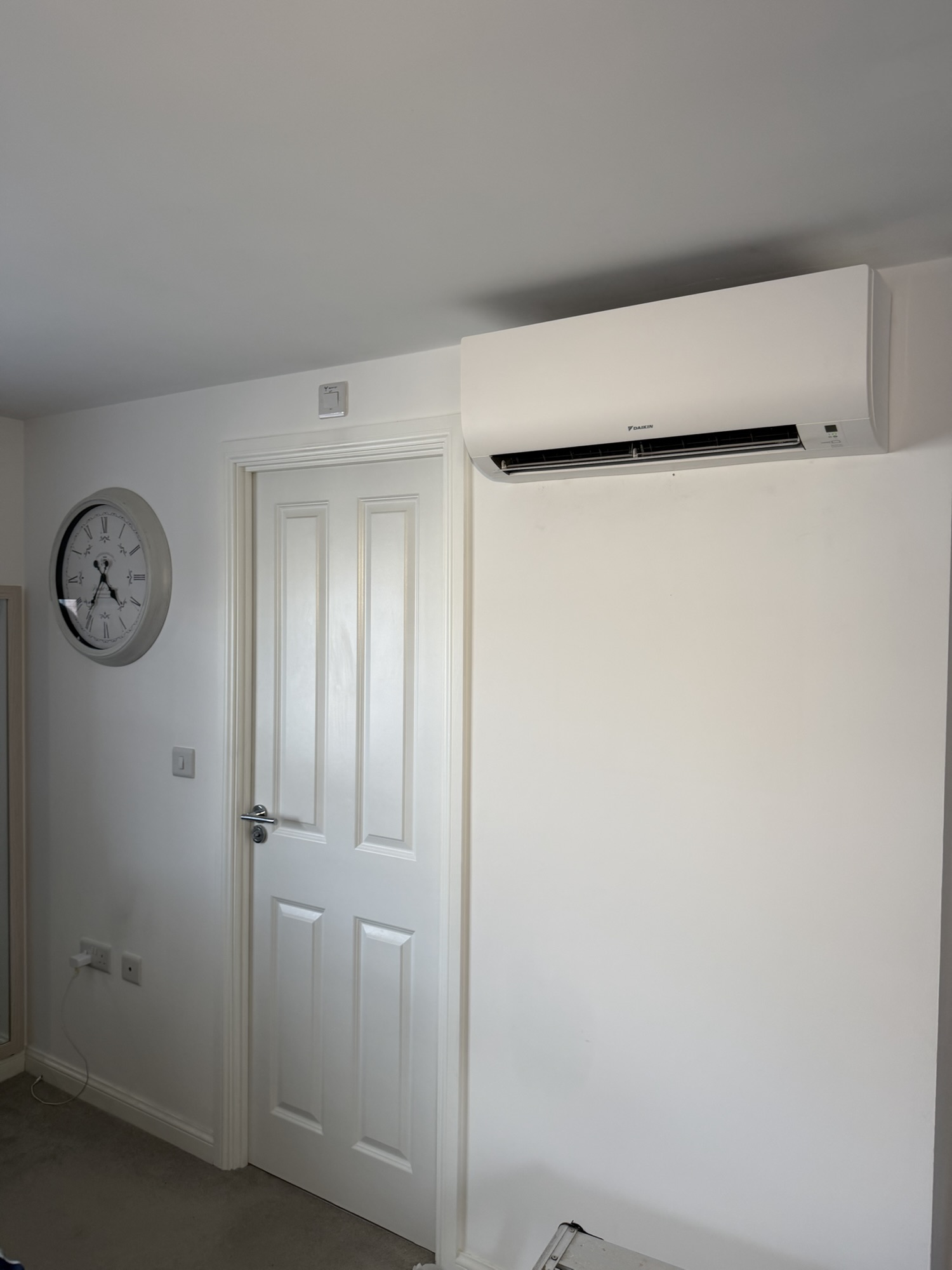
One of the concerns we regularly come across when discussing air conditioning in an existing home is what happens to all the pipework.
If air conditioning wasn’t allowed for when the house was built or renovated, does that mean plastic trunking has to run around the inside of the rooms?
Not necessarily.
A recent Daikin installation gave us a good example of what can sometimes be achieved with a little more time and careful planning.
Retrofitting two Daikin air conditioning units
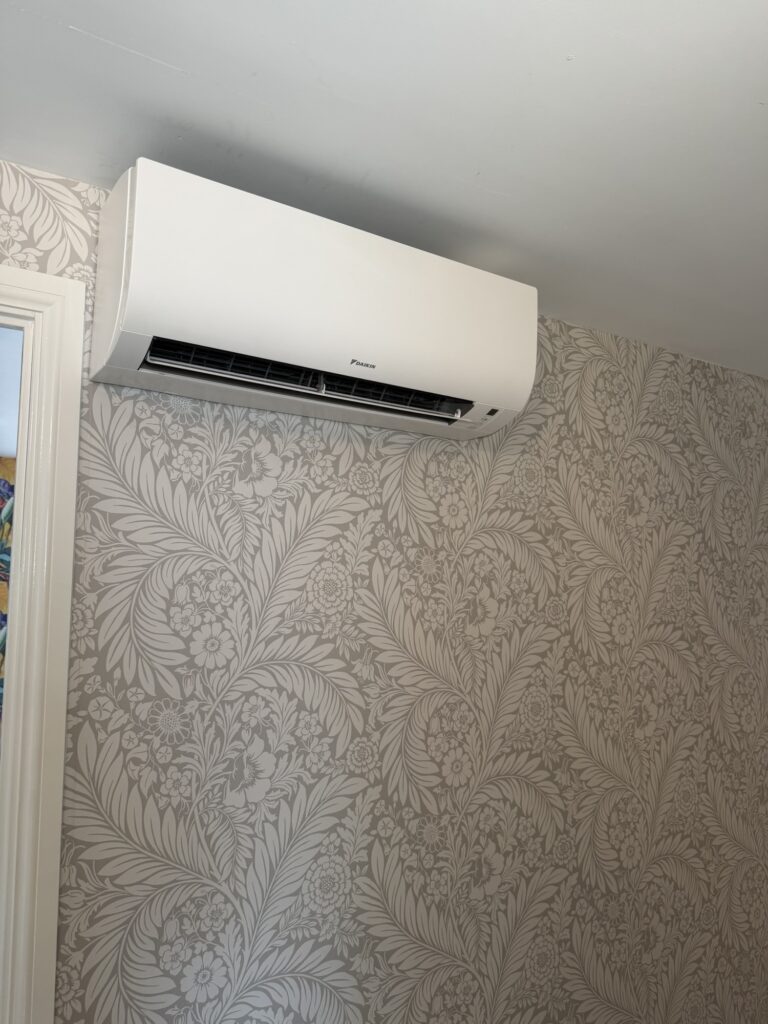
For this property, we installed a 5kW Daikin air conditioning unit on the upstairs landing and a 2.5kW Daikin unit in a bedroom.
There had been no air conditioning first fix. The walls and ceilings were already finished and decorated, so we had to find the best route for all the services retrospectively.
The installation also required condensate pumps, meaning we needed to accommodate not only the refrigerant pipework and electrical connections but also the pumped condensate lines.
Using the existing stud walls
Rather than immediately covering the pipework with surface-mounted internal trunking, Max investigated whether we could make use of the construction of the property itself.
The plasterboard stud walls gave us an opportunity.
By carefully finding a suitable route through the studwork, Max was able to feed the services inside the walls and take them up into the loft. Once in the loft space, the longer pipe runs could be routed out of sight.
It wasn’t the quickest way to install the system, but sometimes spending additional time on the details makes a significant difference to the finished job.
The result is a very discreet retrofit installation without unnecessary trunking running around the rooms.
Does this work in every property?
Unfortunately, no.
Whether air conditioning pipework can be completely concealed depends on the construction of the building, the position of the indoor and outdoor units, access to loft or floor voids and how condensate can be removed.
Solid walls, inaccessible voids and difficult pipe routes can sometimes mean that trunking is still the most practical option.
That’s why we prefer to look at the property rather than promise a particular installation method beforehand.
Where there’s a sensible way to conceal the services, we’ll find it.
Heating as well as cooling
The other reason we’re increasingly installing these systems outside the summer months is that modern air conditioning is also an air-to-air heat pump.
The two Daikin units installed here aren’t going to sit unused until the next heatwave. They can provide efficient heating during colder weather as well as cooling during the summer.
They’re also Wi-Fi ready, giving the customer convenient control of the system.
Most importantly, the customer is delighted with the finished result.
Planning air conditioning for an existing Devon home
If you’re considering air conditioning for an existing property, the installation doesn’t necessarily have to look like an afterthought.
We install Daikin air conditioning and air-to-air heat pump systems in Exmouth, Exeter, East Devon and across our wider Devon service area, from individual bedrooms and living rooms to multi-room and ducted systems.
A survey allows us to consider not only the required heating and cooling capacity, but also where the outdoor equipment can go, condensate drainage and how we can achieve the neatest practical pipe routes.
Qualifying residential air-to-air heat pump installations can also benefit from 0% VAT, with finance options available subject to eligibility.